撰文者:廖珮岑
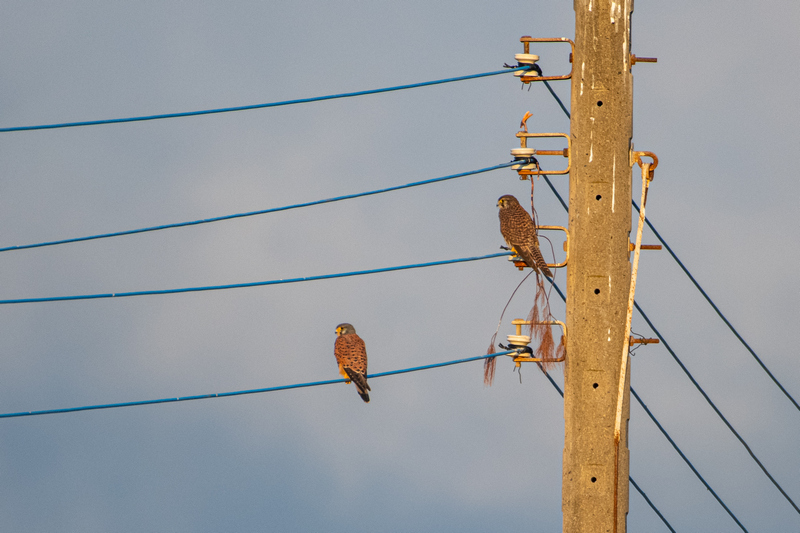
在開闊農地上,遠遠看到一隻紅紅的猛禽正在拍翅定點懸停,極有可能是隻紅隼。紅隼是出名的御風者,牠們擅長利用風,低空飛行巡邏,也可以藉由拍動翅膀停留在高空中,定點觀察地面上的獵物,一看到獵物出沒便能馬上垂直降落襲擊。
牠們御風的能力,也體現在長距離跨海遷徙上,紅隼不只能利用風翱翔,也可以不藉由風自主拍翅前行,因此移動路線極其彈性,通常都是分開遷徙,各走各的路。紅隼遍布整個歐亞大陸,並不是所有紅隼都會遷徙,例如北歐地區的紅隼是真正的遷徙猛禽,每年秋季會大老遠跑到非洲度冬;中歐的紅隼通常只有雌鳥和較年輕的鳥會選擇遷徙;而南歐地區的紅隼則幾乎都是留鳥。不過隨著氣候暖化,食物選擇變多,選擇遷徙的紅隼正在減少,牠們開始傾向停留度冬。
這也歸功於牠們廣泛的食性,紅隼一般喜歡吃老鼠,不過牠們能根據環境進行狩獵上的調整。例如逐漸適應城市生活的紅隼不只更傾向捕食鳥類,牠們還發展出新的覓食策略來捕抓城市裡的蝙蝠和雨燕,牠們會在蝙蝠或雨燕棲息的通風口上方等待伏擊。
原本習慣在洞穴或樹洞中築巢,偶爾也會利用鴉科舊巢繁殖的紅隼,在城市環境中會更頻繁地使用高樓的窗框或陽台等空間築巢,常常打開窗戶突然發現一隻鳥瞪著圓圓黑黑的眼睛,回頭盯著你。
受益於紅隼廣泛的食性和彈性的繁殖環境選擇,有些人開始嘗試在農地附近使用人工巢箱吸引紅隼幫忙捕老鼠,也順便捕鳥類及昆蟲,而紅隼似乎又更喜歡築巢在電線杆上的人工巢箱裡。
隨著全球黑翅鳶迅速的擴散,每年冬季才會來到台灣的紅隼,也因為與黑翅鳶棲位幾乎相同,提高了與黑翅鳶競爭平原棲地的壓力,在台灣的族群量逐漸減少。
延伸閱讀
- 徐沛卓、许青,2023。基于卫星追踪的东北地区红隼冬季家域及移动特点。野生动物学报, 44(3)。
- 蕭義信. (2010). 天線寶寶—一隻連續 4 年在貢寮鄉田寮洋度冬的紅隼. 台灣猛禽研究, (10), 62-64.
- Anushiravani, S., & Sepehri Roshan, Z. (2017). Identification of the breeding season diet of the Common Kestrel, Falco tinnunculus in the north of Iran. Zoology and Ecology, 27(2), 114-116.
- Butet, A., Michel, N., Rantier, Y., Comor, V., Hubert-Moy, L., Nabucet, J., & Delettre, Y. (2010). Responses of common buzzard (Buteo buteo) and Eurasian kestrel (Falco tinnunculus) to land use changes in agricultural landscapes of Western France. Agriculture, ecosystems & environment, 138(3-4), 152-159.
- Carrillo, J., González-Dávila, E., & Ruiz, X. (2017). Breeding diet of Eurasian kestrels Falco tinnunculus on the oceanic island of Tenerife. Ardea, 105(2), 99-111.
- Carrillo-Hidalgo, J. (2022). Misdirected incubation in Common Kestrels Falco tinnunculus: a case of visual stimulus?. Biodiversity Observations, 12, 46-53.
- Chen, K. H., Lin, W. L., & Lin, S. M. (2022). Competition between the black‐winged kite and Eurasian kestrel led to population turnover at a subtropical sympatric site. Journal of Avian Biology, 2022(10), e03040.
- García-Silveira, D., Lopez-Ricaurte, L., Hernández-Pliego, J., & Bustamante, J. (2022). Long-range movements of common kestrels (Falco tinnunculus) in Southwestern Spain revealed by GPS tracking. Journal of Raptor Research, 56(3), 346-355.
- Haddad, E., & Yosef, R. (2022). Cannibalism in common kestrel (Falco tinnunculus). acta ethologica, 25(3), 195-197.
- Hochleitner, L., Korpimäki, E., Chakarov, N., Isaksson, C., Nebel, C., Renner, S. C., ... & Sumasgutner, P. (2024). Diet diversity, individual heterozygosity and habitat heterogeneity influence health parameters in Eurasian Kestrels (Falco tinnunculus). Ibis.
- Huchler, K., Schulze, C. H., Gamauf, A., & Sumasgutner, P. (2020). Shifting breeding phenology in Eurasian kestrels Falco tinnunculus: Effects of weather and urbanization. Frontiers in Ecology and Evolution, 8, 545541.
- Jones, G. C. A., Woods, D., Broom, C. M., Panter, C. T., Sutton, L. J., Drewitt, E. J. A., & Fathers, J. (2024). Fine-Scale Spatial Variation in Eurasian Kestrel Falco tinnunculus Diet in Southern England Revealed from Indirect Prey Sampling and Direct Stable Usotope Analysis. Ardea, 112(1), 129-141.
- Kangas, V. M., Carrillo, J., Debray, P., & Kvist, L. (2018). Bottlenecks, remoteness and admixture shape genetic variation in island populations of Atlantic and Mediterranean common kestrels Falco tinnunculus. Journal of Avian Biology, 49(10), e01768.
- Kitowski, I. (2014). The response of Eurasian kestrel Falco tinnunculus to falconry at Deblin military airfield, east Poland. Turkish journal of zoology, 38(3), 298-305.
- Kreiderits, A., Gamauf, A., Krenn, H. W., & Sumasgutner, P. (2016). Investigating the influence of local weather conditions and alternative prey composition on the breeding performance of urban Eurasian Kestrels Falco tinnunculus. Bird Study, 63(3), 369-379.
- Montoya, A., Cabodevilla, X., Fargallo, J. A., Biescas, E., Mentaberre, G., & Villanúa, D. (2021). Vertebrate diet of the common kestrel (Falco tinnunculus) and barn owl (Tyto alba) in rain-fed crops: implications to the pest control programs. European Journal of Wildlife Research, 67(5), 79.
- Morganti, M. (2021). Common kestrel Falco tinnunculus. In Migration Strategies of Birds of Prey in Western Palearctic (pp. 212-216). CRC Press.
- Mikula, P., Hromada, M., & Tryjanowski, P. (2013). Bats and Swifts as food of the European Kestrel (Falco tinnunculus) in a small town in Slovakia. Ornis Fennica, 90(3).
- Roos, S., Campbell, S. T., Hartley, G., Shore, R. F., Walker, L. A., & Wilson, J. D. (2021). Annual abundance of common Kestrels (Falco tinnunculus) is negatively associated with second generation anticoagulant rodenticides. Ecotoxicology, 30(4), 560-574.
- Rzępała, M., Kasprzykowski, Z., Obłoza, P., Mitrus, C., & Golawski, A. (2023). The influence of habitat and the location of nest-boxes on the occupation of boxes and breeding success of the Kestrel Falco tinnunculus. The European Zoological Journal, 90(1), 1-9.
- Siverio, F., Trujillo, D., González, C., & Rodríguez, B. (2024). Alloparental Care of Eurasian Kestrel (Falco tinnunculus) Broods by Barbary Falcon (F. peregrinus pelegrinoides). Journal of Raptor Research.
- Spadetto, L., García-Fernández, A. J., Zamora-López, A., Zamora-Marín, J. M., León-Ortega, M., Tórtola-García, M., ... & Gómez-Ramírez, P. (2024). Comparing anticoagulant rodenticide exposure in barn owl (Tyto alba) and common kestrel (Falco tinnunculus): a biomonitoring study in an agricultural region of Southeastern Spain. Environmental Pollution, 124944.
- Sumasgutner, P., Nilles, T., Hykollari, A., de Chapa, M. M., Isaksson, C., Hochleitner, L., ... & Fusani, L. (2023). Integument colouration and circulating carotenoids in relation to urbanisation in Eurasian kestrels (Falco tinnunculus). The Science of Nature, 110(5), 48.
- Wang, Y., Liu, H., Wang, H., Wang, Y., Ma, L., & Yi, G. (2019). Polygyny in the Eurasian kestrel (Falco tinnunculus): behavior, morphology, age, heterozygosity, and relatedness. Journal of Raptor Research, 53(2), 202-206.