撰文者:廖珮岑
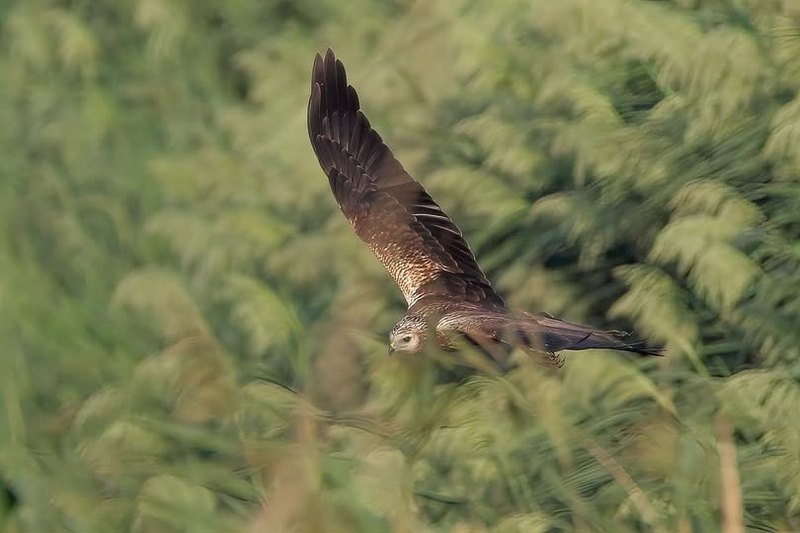
如果有一天行經沼澤溼地,發現原本看似沒有鳥類的沼澤地,突然出現水鳥在空中群起驚飛,或許可以仔細搜尋遠方高草處是否有猛禽低空越過,那或許會是一隻東方澤鵟正在覓食。
東方澤鵟喜歡在充滿複雜水道的沼澤高草上空緩慢滑行,藉此驚動躲藏在高草叢深處的獵物,以提高狩獵的成功率。不過沼澤環境可不只有鳥類,還有許多老鼠,東方澤鵟的狩獵目標除了鳥類,也會捕食老鼠和其他小型哺乳類,偶爾吃魚。
牠們喜歡將濕地的芒草、蘆葦等乾草堆疊在地面,並在上面繁殖。根據日本學者的觀察研究,東方澤鵟的繁殖地和覓食地通常會分開,這也讓有東方澤鵟繁殖的沼澤地,成為鳥類豐富度較高的棲地指標,因為有東方澤鵟存在的沼澤地,等於是多了一層保護的效果,避免其他獵食者的攻擊。
東方澤鵟繁殖於俄羅斯東邊、蒙古、中國東北和日本,俄羅斯的貝加爾湖剛好是西方澤鵟和東方澤鵟的繁殖重疊區域,兩者雜交的個體偶爾會被觀察記錄到。東方澤鵟在秋季會展開遷徙至日本、台灣、中國南邊、菲律賓、印尼等地度冬。每當冬季經過台灣濕地之時,可以仔細觀察是否正有過境或是來台灣度冬的東方澤鵟正在低飛覓食。
延伸閱讀
- Chiba A. & Sato G. (2008). On the breeding of the Eastern Marsh Harrier Cirucus spilonotus in the Sakata of Niigata City. Strix 26:81-95.
- Fefelov, I. V. (2001). Comparative breeding ecology and hybridization of Eastern and Western Marsh Harriers Circus spilonotus and C. aeruginosusin the Baikal region of Eastern Siberia. Ibis, 143(3), 587-592.
- Fitzsimons, J. (2005). Attempted predation on a Large-tailed Nightjar (Caprimulgus macrurus) by an Eastern Marsh-Harrier (Circus spilonotus) in coastal Vietnam. Journal of Raptor Research, 39(1):106-107.
- Hirano T. (2008). The Habitat use of hunting Eastern Marsh Harriers wintering in Watarase Marsh. Bird Research 4:A9-A18.
- Nagai, K., Takahashi, Y., Yamazaki, S., & Azuma, A. (2018). Analysis of the genetic diversity and structure of the Eastern Marsh Harrier in Japan using mitochondrial DNA. Journal of ornithology, 159, 73-78.
- Nayak, A. K. (2022). Report of occurrence of Eastern Marsh Harrier from Bankura District, West Bengal, India. ZOO'S PRINT, 37(9), 41-44.
- Naya H., Koumizu G. & Shimizu T. (2007). Breeding confirmation of the Eastern Marsh Harrier in Osaka Prefecture. Strix 25:99-103.
- Oatley, G., Simmons, R. E., & Fuchs, J. (2015). A molecular phylogeny of the harriers (Circus, Accipitridae) indicate the role of long distance dispersal and migration in diversification. Molecular phylogenetics and evolution, 85, 150-160.
- Senzaki, M., Yamaura, Y., & Nakamura, F. (2017). Predicting off‐site impacts on breeding success of the marsh harrier. The Journal of Wildlife Management, 81(6), 973-981.
- Senzaki, M., & Yamaura, Y. (2016). Surrogate species versus landscape metric: does presence of a raptor species explains diversity of multiple taxa more than patch area? Wetlands ecology and management, 24, 427-441.
- Senzaki, M., Yamaura, Y., & Nakamura, F. (2015). The usefulness of top predators as biodiversity surrogates indicated by the relationship between the reproductive outputs of raptors and other bird species. Biological Conservation, 191, 460-468.
Tada H. (2007). The breeding record of the Eastern Marsh Harrier in Hotokenuma March. Strix 25:87-93.